KS2 Science Year-End Paper 1
Time: 45 minutes
Marks: 40
End-of-year Year-6 science practice paper (40 marks, short contexts, 1-3 mark parts).
1 Growing beans [5]
Two trays of beans. Both have damp compost and daily water. Tray A is on a windowsill. Tray B is in a cupboard. After 10 days A has tall green shoots. B has pale thin shoots.
(a) Name the factor that is different. [1]
(b) Why must soil and watering stay the same? [1]
(c) Tick the green substance in leaves. chlorophyll / protein / enamel [1]
(d) A child says tray B proves plants do not need light, because something grew. Explain why that is wrong. [2]
2 The pulse [4]
Rest pulse 72 beats in one minute. After a run, 110 beats in one minute.
(a) Which organ makes the pulse? [1]
(b) Why did the number go up? [2]
(c) After sitting, the pulse is 76. What does that show? [1]
3 Ice, water, steam [5]
(a) Match: ice to liquid water; liquid water to ice; liquid water to steam.
Words: melting / freezing / evaporating [2]
(b) In which state are particles closest together? [1]
(c) Steam on a cold mirror becomes droplets. Name the change. [1]
(d) Is melting ice reversible? Yes or no, and why. [1]
4 Circuits [6]
One cell, one lamp, wires, a switch.
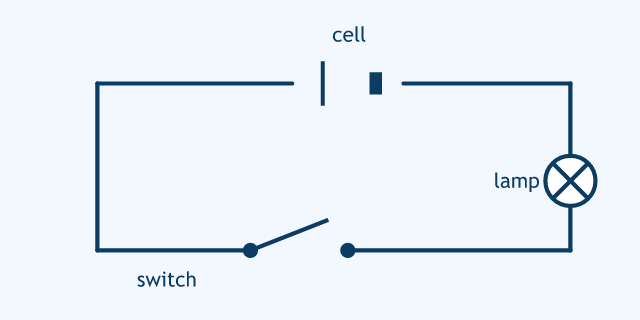
(a) The lamp is off. Give two different possible reasons. [2]
(b) A second cell is added the same way round. The loop is complete. What happens to the lamp? [1]
(c) A second lamp is then put in the same loop. Both glow. Brighter, dimmer or the same as one lamp with two cells? [1]
(d) Draw the symbol for a lamp and for an open switch. [2]
5 Shadows [4]
A lamp, a wooden block, a dark shape on the wall.
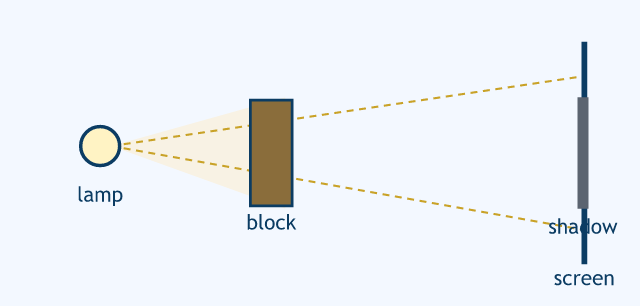
(a) What is a shadow? [1]
(b) The block is moved closer to the lamp. What happens to the size of the shadow? [1]
(c) The wood is swapped for a clear glass cube. What happens to the shadow? Explain. [2]
6 Teeth and food chains [5]
(a) Which teeth cut food? [1]
(b) Which teeth grind food? [1]
(c) One way to protect enamel. [1]
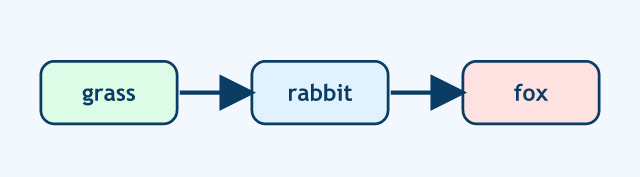
(d) grass → rabbit → fox. Name the producer. Name a predator. [2]
7 Rocks and fossils [5]
(a) A rock fizzes with acid and holds tiny shells. granite / marble / limestone [1]
(b) Name two things you might find in garden soil. [2]
(c) Why is a fossil not a plastic toy from last week? [2]
8 Friction investigation [6]
Same shoe, same pull, three surfaces: smooth plastic, wood, rough mat.
(a) What should change? [1]
(b) Name one thing to keep the same. [1]
(c) Which surface should give the most friction? [1]
(d) Why is friction useful on a shoe? [1]
(e) Write a conclusion that uses the word friction. [2]